
How to Tie the Double Bowline
The Water Bowline
The Water Bowline, also known as a the water bowline (sort of), is a secure variation of the bowline knot used to create a fixed loop in a rope, making it particularly useful in marine, rescue, and outdoor applications where the knot may be exposed to movement, vibration, or wet conditions. It is valued for its extra turn around the standing part, which provides additional security and helps reduce the likelihood of the knot loosening under load. Because of this combination of strength, stability, and practicality, the Water Bowline is commonly used whenever a dependable end-of-line loop is needed for attaching to anchors, mooring points, or other fixed objects.
Water Bowline Instructions
The Water Bowline is a loop knot and a variation of the Bowline. Commonly used in sailing, boating, rescue, and general rope-work applications, the Water Bowline is preffered where greater security than a standard bowline is needed. Its structure is based on the classic bowline but incorporates an additional round turn around the standing part before the loop is completed. This modification helps distribute load more effectively, improves stability, and enhances resistance to loosening while maintaining the bowline’s familiar characteristics. The Water Bowline is recognized as a distinct bowline variation, and it is included in The Ashley Book of Knots (ABOK #1012).
It’s important to understand that while the Water Bowline looks like, and is very similar to, the Double Bowline, and is often talked about interchangeably, there is a slight difference in both knots.
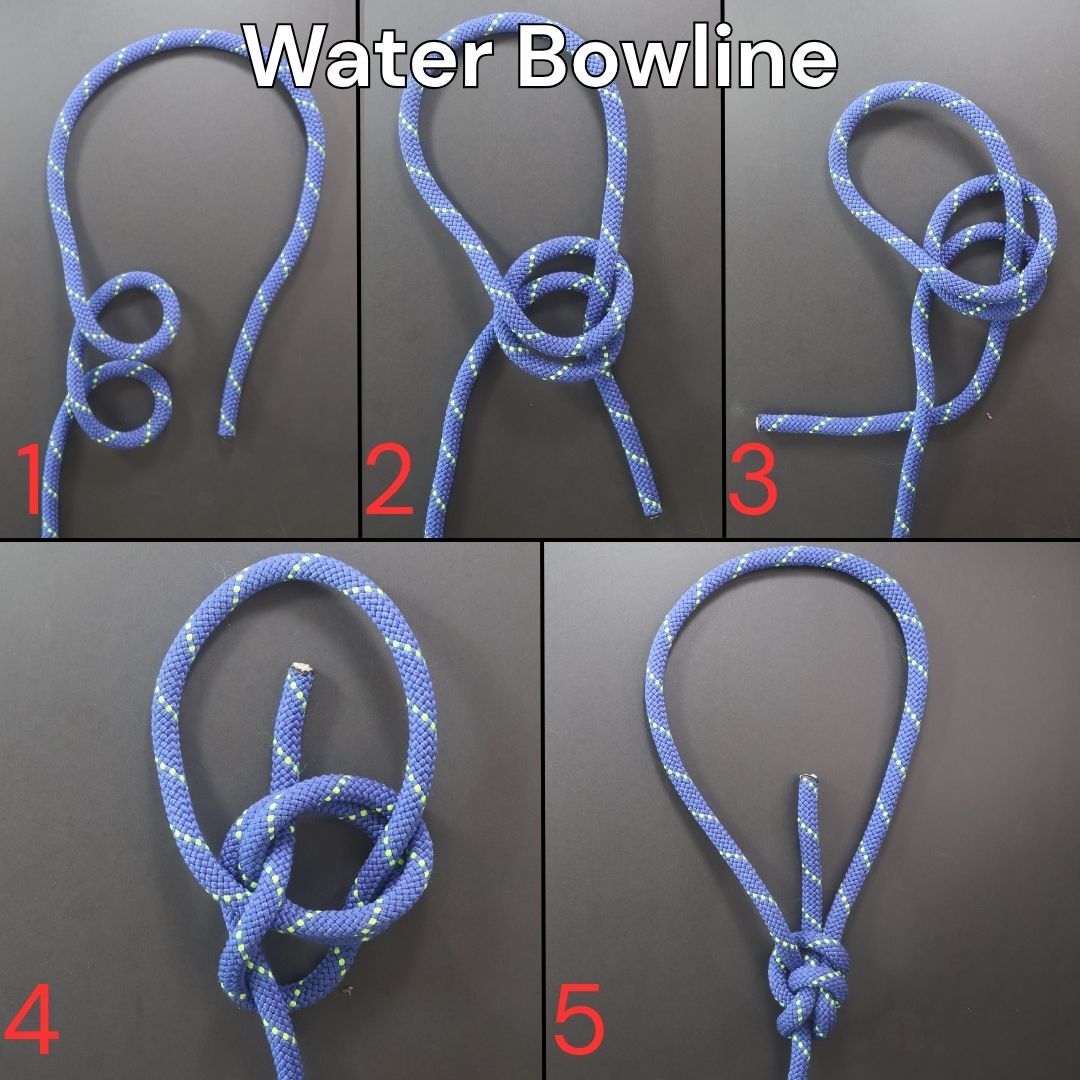
Key Considerations
Proper dressing of the Water Bowline is important to ensure the knot is correctly formed and performs as intended. The extra turn must be arranged neatly and tightened carefully so that all parts of the knot are properly seated. Careful dressing and setting help maximize security and reduce the risk of incorrect tying. As with all bowline variations, the finished knot should be visually inspected and checked before use to confirm that it has been tied correctly and that an adequate tail remains.
Advantages & Disadvantages
One of the key advantages of the Water Bowline is its increased resistance to loosening while remaining relatively easy to untie after bearing load. It retains many of the desirable characteristics of the traditional bowline while providing additional security through its extra turn, making it a popular choice in marine and outdoor environments. It can be tied efficiently with practice and remains practical in situations where both reliability and convenience are important.
However, like any knot used in life-safety or load-bearing applications, it should only be used by individuals who are properly trained in its construction, inspection, and appropriate use.
ABOK #1012 - The Water Bowline
ABOK Numbers: Abok #1012
In Ashley’s Book of Knots, the Water Bowline is described as:
Abok #1012,
‘If a Bowline is to be towed through the water a second Half Hitch may be added. Wet knots are apt to jam, and the extra hitch lessens this tendency.’
Disclaimer
The information on this website is provided for educational and informational purposes only. While every effort has been made to ensure accuracy, knot strength, security, and suitability can vary depending on rope type, condition, load, environmental factors, and how the knot is tied. Users are responsible for inspecting their equipment and verifying that a knot is appropriate for their intended use. Do not rely solely on the information provided here for activities involving personal safety, life support, climbing, rescue operations, heavy lifting, or other high-risk applications.
SCB Media Group assumes no responsibility or liability for any injury, loss, damage, or consequences resulting from the use or misuse of the knots and techniques described. Always seek professional instruction and follow applicable safety standards where appropriate.
The Bowline is one of the most well-known and widely used loop knots in The Ashley Book of Knots (ABOK), where it serves as the foundation for numerous related loop knot variations. The standard Bowline is listed as ABOK #1010 and is valued for creating a secure fixed loop that does not tighten under load while remaining relatively easy to untie after use. Its simplicity, versatility, and long history have made it a cornerstone knot in sailing, climbing, rescue work, and general ropecraft.
In Abok, the Bowline (Abok #1010) is described as:
‘The Bowline, Bowling, or Bolin Knot, sometimes called Bowling’s Knot. The name is derived from bow line, a rope that holds the weather leech of a square sail forward and prevents the sail from being taken aback. As the line or rope that provided the knot is no longer in use, the Bowline Knot is nowadays very apt to be termed merely the “Bowline,” the word knot being dropped.
Captain John Smith says of So the knot: “The Boling Knot is firmely made and fastened by the bridles into the creengles of the sailes, they will breake, or the saile split before it will slip.” But no knot is safe that is not properly drawn up, which will explain probably the following contradictory statement from Alston’s Seamanship of 1871: “With a heavy strain a bowline knot often capsizes.” However, it is a fact that no knot is safe except under reasonable conditions. Properly tied in ordinary rope, there is little or no danger of a Bowline’s Knot capsizing before the breaking point of the rope itself is reached. It is so good a knot that the sailor seldom uses any other Loop Knot aboard ship.
A Bowline is frequently used as a hitch when tying a boat painter a ring. On a whaler it is tied around a man’s waist to make a “monkey rope,” which is required if he is to be lowered overside for any purpose. When mooring, Bowlines are tied in hawsers and tossed over bollards. Two interlocked Bowlines are a common form of Hawser Bend. It is often said at sea that “the divil would make a good sailor, if he could only tie a bowline and look aloft.”
To tie the knot: Grasp the end of a rope in the right hand and the standing part in the left hand. Cross the end of the rope over the standing part, and with a turn of the right wrist put a single hitch around the rope end. Without shifting the grip of the right hand, pass the end of the rope to the left under the standing part, then down through the hitch that was first formed.
In Abok, Abok #1011, a traditional bowline with the tag end lashed to the loop, is described as,
‘The Standing Bowline. This name properly belongs to a Bowline Knot that has been seized, as on a boatswain’s chair.’
Finally, Abok #1716, the Bowline Hitch, is a Bowline around an object, and described as,
‘The Bowline Hitch: A sailor will often, having passed his rope around an object, face about and tie a Bowline in the regular fashion. A landsman who is acquainted with the knot will usually form the round turn (shown in second diagram) with his left hand and reeve the end as shown by the arrow. The preferred sailor way is to make a Half hitch, as in the first diagram, and then capsize it by pulling the end. The knot is then completed as shown by arrow.’