
How to Tie the Ashley Stopper Knot
The Ashley Stopper
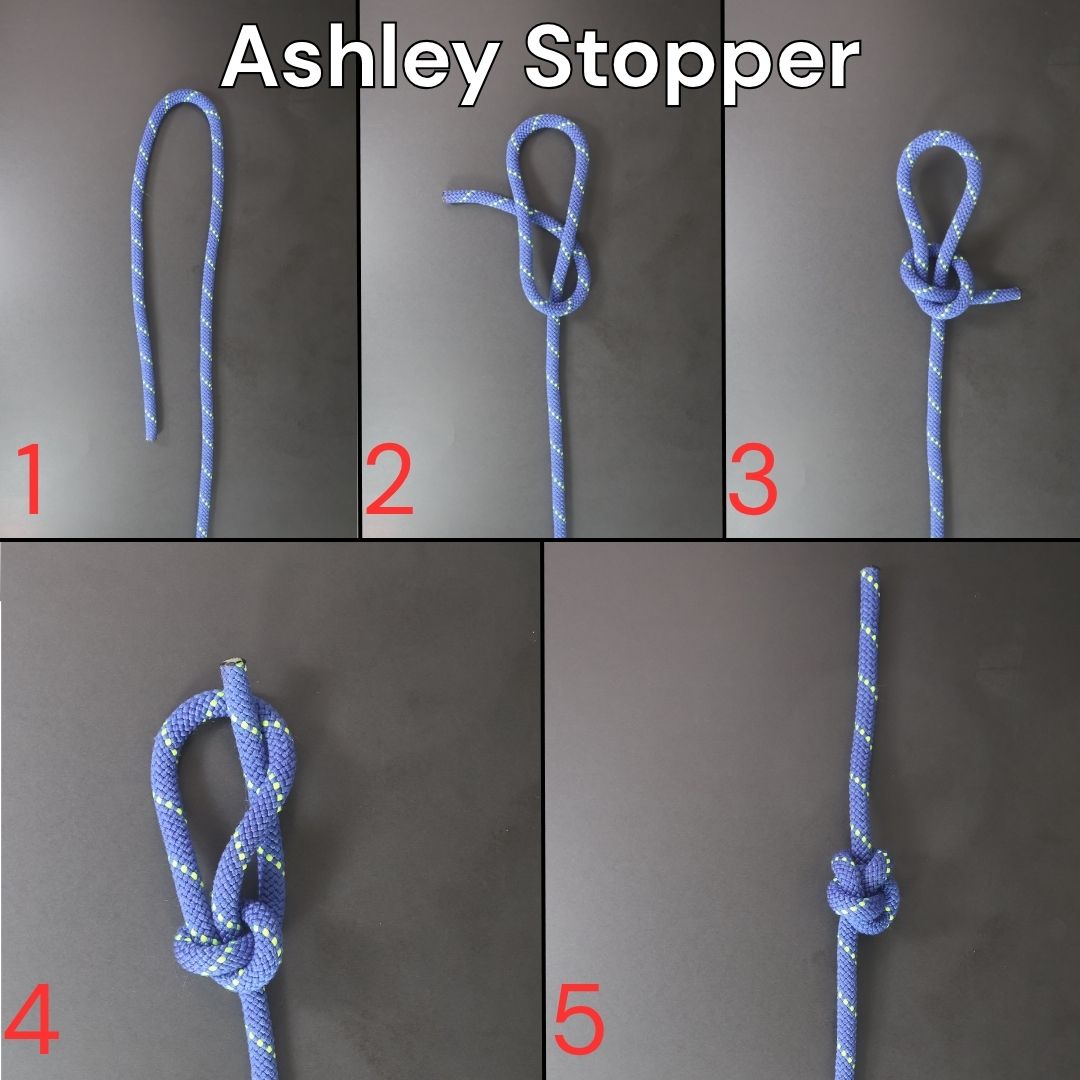
The Ashley Stopper Knot, also known as the Oysterman's Stopper, is a secure stopper knot used to create a bulky end in a rope, helping to prevent the rope from slipping through holes, blocks, pulleys, or other openings. It is valued for its compact yet substantial structure, which provides excellent stopping power while remaining relatively easy to untie after loading. Because of this combination of security, strength, and practicality, the Ashley Stopper Knot is commonly used whenever a dependable stopper knot is needed to prevent accidental rope run-through or to provide a secure handhold at the end of a line.
Other Names: Oysterman's Stopper
The Ashley Stopper Instructions
Today, the Ashley Stopper Knot (Oysterman’s Stopper) is widely used in sailing, climbing, rescue, and general rope-work applications where a reliable stopper knot is desired. Its structure was developed by Clifford W. Ashley and is designed to create a symmetrical, compact knot that resists slipping while maintaining good strength characteristics. Compared to simpler stopper knots, it provides a larger and more secure stopping profile without becoming excessively bulky. The Ashley Stopper Knot is included in The Ashley Book of Knots (ABOK #526) and is regarded as one of the most effective stopper knots in common use.
Key Considerations
Proper dressing of the Ashley Stopper Knot is important to ensure the knot is correctly formed and performs as intended. The turns and crossings should be arranged neatly and tightened carefully so that all parts of the structure are properly seated. Careful dressing and setting help maximize security, maintain the knot’s symmetrical shape, and reduce the risk of incorrect tying. As with all knots, the finished knot should be visually inspected before use to confirm that it has been tied correctly and fully tightened.
Advantages & Disadvantages
One of the key advantages of the Ashley Stopper Knot is its combination of excellent stopping power and relative ease of untying after heavy loading. It offers greater security and a more substantial profile than many simpler stopper knots while remaining practical for everyday use. It can be tied efficiently with practice and remains a popular choice among sailors, climbers, and rope enthusiasts who need a dependable stopper knot. However, like any knot used in load-bearing applications, it should be properly tied, dressed, and inspected before use to ensure reliable performance.
For a more discrete and smaller stopper knot, see the Double Overhand Stopper or the Figure Eight Stopper.
ABOK #526 - Oysterman's Stopper
ABOK Numbers: Abok #526
The Ashley Stopper Knot is featured in Ashley’s Book of Knots as the Oysterman’s Stopper Knot. The stopper knot was developed by Clifford Ashley (or coined by him); you can read the full story in his book on Page 7 of Chapter one, as is described below.
Abok #526,
‘The discovery of this knot is described in Chapter 1, page 7. It is a larger knot than the Figure Eight, which has but one part around the stem. The Oysterman’s Stopper Knot has three rim parts, and these are quite symmetrical when viewed from the underside. From this view it closely resembles a Three-Strand Wall Knot. The end is nipped by a single top part. It is easy to tie and practical to use when the hole that is to be filled is too large for the Figure-Eight. Having reached the position of the upper right diagram and the end being rove as indicated by the arrow, the Half Knot shown near the end in the diagram must be pulled very snug; next the end is pulled and finally the standing part. Arrange the knot so that it is symmetrical as in the left and right bottom sketches. The center bottom diagram is given merely to show the over-and-under arrangement of the knot on a symmetrical diagram form.’
Disclaimer
The information on this website is provided for educational and informational purposes only. While every effort has been made to ensure accuracy, knot strength, security, and suitability can vary depending on rope type, condition, load, environmental factors, and how the knot is tied. Users are responsible for inspecting their equipment and verifying that a knot is appropriate for their intended use. Do not rely solely on the information provided here for activities involving personal safety, life support, climbing, rescue operations, heavy lifting, or other high-risk applications.
SCB Media Group assumes no responsibility or liability for any injury, loss, damage, or consequences resulting from the use or misuse of the knots and techniques described. Always seek professional instruction and follow applicable safety standards where appropriate.