
How to Tie the Stevedore Stopper Knot
The Stevedore Stopper
The Stevedore Stopper Knot is a secure stopper knot used to create a large, bulky end in a rope, helping to prevent the line from slipping through holes, fairleads, blocks, or other openings. It is valued for its substantial size and excellent stopping power, which make it more effective than many simpler stopper knots. Because of this combination of security, strength, and practicality, the Stevedore Stopper Knot is commonly used in sailing, rigging, and general rope-work applications whenever a dependable end stopper is required.
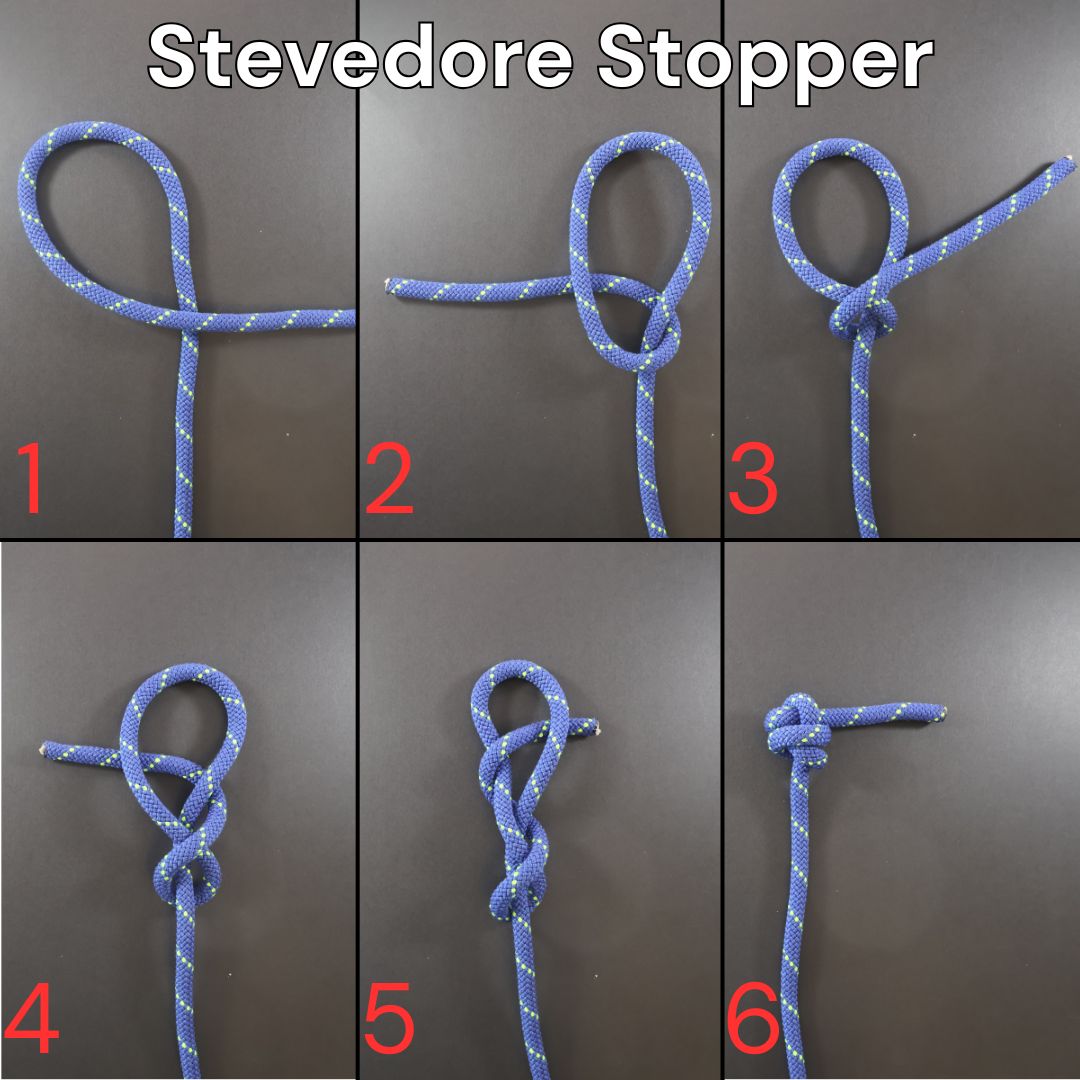
Stevedore Stopper Knot Instructions
Today, the Stevedore Stopper Knot is widely used in marine and industrial settings where a larger stopper knot is preferred. Its structure is similar to the Figure Eight Stopper Knot but incorporates an additional turn before the knot is completed, creating a bulkier and more substantial profile. This modification increases the stopper knot’s ability to resist pulling through openings while maintaining good strength characteristics. The Stevedore Stopper Knot is included in The Ashley Book of Knots (ABOK #456 & #522). and has long been recognized as an effective stopper knot for heavy-duty applications.
Key Considerations
Proper dressing of the Stevedore Stopper Knot is important to ensure the knot is correctly formed and performs as intended. The turns should be arranged neatly and tightened evenly so that the knot forms a compact and symmetrical shape. Careful dressing and setting help maximize stopping power, improve stability, and reduce the risk of incorrect tying. As with all stopper knots, the finished knot should be visually inspected before use to confirm that it has been tied correctly and fully tightened.
Advantages & Disadvantages
One of the key advantages of the Stevedore Stopper Knot is its ability to create a larger and more secure stopper than a standard Figure Eight Knot while remaining relatively easy to tie. It provides excellent resistance to pulling through openings and performs well under heavy loads, making it particularly useful in marine and rigging environments. Although it may become more difficult to untie after significant loading, its reliability and substantial stopping profile make it a popular choice whenever maximum stopping power is desired. However, like any knot used in load-bearing applications, it should be properly tied, dressed, and inspected before use to ensure reliable performance.
ABOK #456 - Stevedore Knot
ABOK Numbers: Abok #456, Abok #522
The Stevedore Stopper Knot is featured twice in Ashley’s Book of Knots. Both references are as follows:
Abok #456,
‘The Stevedore Knot is a Single-Strand Stopper Knot tied in the end of a rope to prevent unreeving.’
Abok #522,
‘The Stevedore Knot prevents the end of a cargo fall from unreeving; the cargo block, having larger shivs than the ordinary tackle aboard ship, requires a bulky knot. The bight is given one more half turn than in the former knot, before the end is finally stuck.’
Disclaimer
The information on this website is provided for educational and informational purposes only. While every effort has been made to ensure accuracy, knot strength, security, and suitability can vary depending on rope type, condition, load, environmental factors, and how the knot is tied. Users are responsible for inspecting their equipment and verifying that a knot is appropriate for their intended use. Do not rely solely on the information provided here for activities involving personal safety, life support, climbing, rescue operations, heavy lifting, or other high-risk applications.
SCB Media Group assumes no responsibility or liability for any injury, loss, damage, or consequences resulting from the use or misuse of the knots and techniques described. Always seek professional instruction and follow applicable safety standards where appropriate.