
How to Tie the Overhand Knot
The Overhand Knot
The Overhand Knot is one of the simplest and most fundamental knots used to create a stopper at the end of a rope, helping to prevent the line from slipping through openings or unraveling. It is valued for its ease of tying, compact size, and versatility, making it one of the first knots learned by beginners. Because of this combination of simplicity and practicality, the Overhand Knot is commonly used as a basic stopper knot, a component of more complex knots, and a general-purpose knot in a wide variety of rope-work applications.
Other Names: Thumb Knot, Simple Knot, Single Knot, Ordinary Knot, Common Knot
Overhand Knot Instructions
The Overhand Knot may be the most widely used rope knot of all time. If you handed someone a rope, who knows nothing about knots, and said, ‘tie a knot’, nine times out of ten they will tie an overhand knot. The Overhand Knot is fundamental to understanding hundreds of other loop knots, hitch knots, and many other categories. Today, the Overhand Knot is used throughout climbing, sailing, camping, scouting, rescue, and everyday rope work. Its structure consists of a single loop through which the working end is passed and tightened, creating a compact knot that can be tied quickly with minimal effort. Despite its simplicity, the Overhand Knot serves as the foundation for numerous other knots, including the Double Overhand Stopper, Overhand on a Bight, and many other knots. The Overhand Knot is included in The Ashley Book of Knots (ABOK #46).
In this specific post, we reference the Overhand Knot in the Stopper Knots category. However, the Overhand Knot is very versatile and may also be considered binding or hitching depending on the situation. In practise, experienced knotters will not use the Overhand Knot for many situations unless in a temporary capacity.
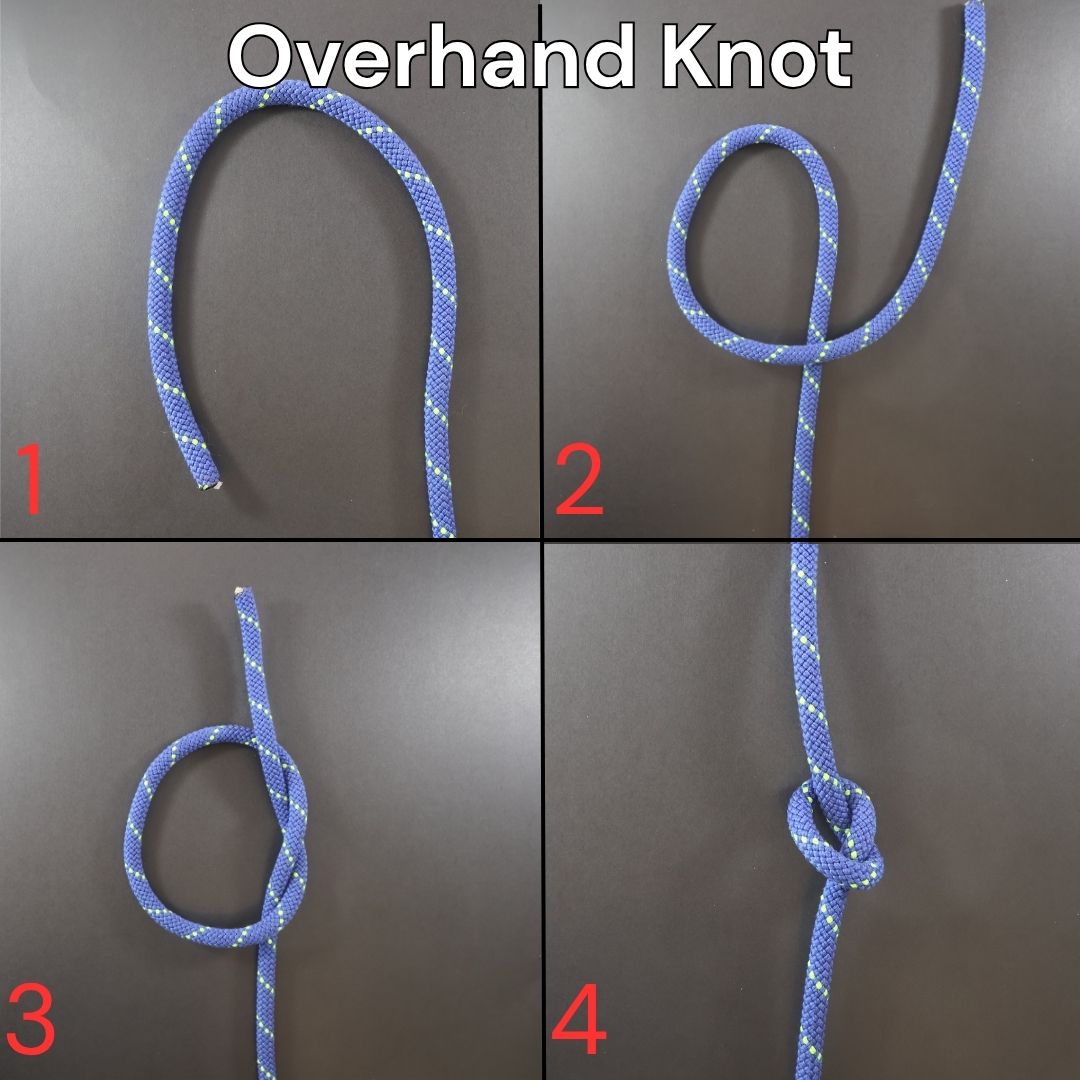
Key Considerations
Proper dressing of the Overhand Knot is important to ensure the knot is correctly formed and performs as intended. The knot should be tightened evenly so that the strands lie neatly against one another without unnecessary twists. Careful dressing and setting help maintain consistency and reduce the risk of the knot becoming misshapen under load. As with all knots, the finished knot should be visually inspected before use to confirm that it has been tied correctly and fully tightened.
Advantages & Disadvantages
One of the key advantages of the Overhand Knot is its exceptional simplicity and versatility. It can be tied in seconds, requires very little rope, and serves as a building block for countless other knots. The main advantage for individuals learning the Overhand Knot is the fundamental knowledge it provides as a basis for other knots.
However, the knot can reduce rope strength significantly and may become difficult to untie after being heavily loaded. Despite these limitations, its ease of use and broad range of applications make it one of the most important and frequently used knots in rope work.
ABOK #46 - The Overhand Knot
ABOK Numbers: Abok #4, Abok #46, Abok #514, Abok #515, Abok #519
The Overhand Knot is featured many times in Ashley’s Book of Knots. The five entries are as follows:
Abok #46,
‘The Overhand is the simplest of the Single-Strand Stopper Knots, and is tied with one end around its own standing part, purpose being to prevent unreeving.’
Abok #514,
‘The Overhand Knot, also called Simple, Single, Thumb, Common, and Ordinary Knot, is the simplest of all knot forms and is the point of departure for many of the more elaborate knots. It is quite secure but very weak, reducing the strength of the rope in which it is tied by perhaps as much as fifty per cent. It also jams and is difficult to untie, often injuring the fiber. For these reasons it should be tied only in small material that is not to be employed again, and where there is considerable margin of strength.
The name Overhand Knot appears in Steel’s Elements & Practice of Rigging, 1794. Formerly the knot was tied in square-sail reef points which, after reeving through eyelet holes in the sail, were knotted closely at either surface. It is the knot universally used in sewing thread and twine, and riggers put it in the ends of spun-yarn seizings. On jib-boom footropes the Overhand Knot is sometimes tied at regular intervals to prevent feet from slipping, but except for single purpose it is seldom tied in rope at sea, as the Figure-Eight Knot is both stronger and easier to untie. this
Ashore the Overhand Knot is frequently employed to prevent raveling and unreeving. Formerly carriage whips were hung up by Overhand Knots, which were tied in the ends of the fly or snapper. Its chief merit is its compactness. It is the smallest of all knots, and expends the least material.’
Abok #515,
‘The name Thumb Knot is applied particularly when the knot is tied by one hand, as it commonly is in sewing thread and twine. The name with this meaning is given in Emerson’s Mechanics of 1794. So tied, it may be either a single or a Double Overhand Knot. A loose round turn is made about the tip of the forefinger. When thumb is extended the end rolls through the turn once or twice. The standing part of the thread is then pulled, and the knot is formed under the nail of the second finger. The technique varies, however, with the individual.’
Abok #519,
‘The Overhand Knot is repeated here as the basic knot for another series of a different character, the second of this series being the Figure-Eight Knot and the fourth the Stevedore Knot. To make the Overhand Knot: First make a turn and then reeve the end through the turn as pictured.’
Disclaimer
The information on this website is provided for educational and informational purposes only. While every effort has been made to ensure accuracy, knot strength, security, and suitability can vary depending on rope type, condition, load, environmental factors, and how the knot is tied. Users are responsible for inspecting their equipment and verifying that a knot is appropriate for their intended use. Do not rely solely on the information provided here for activities involving personal safety, life support, climbing, rescue operations, heavy lifting, or other high-risk applications.
SCB Media Group assumes no responsibility or liability for any injury, loss, damage, or consequences resulting from the use or misuse of the knots and techniques described. Always seek professional instruction and follow applicable safety standards where appropriate.