
How to Tie a Bowline on a Bight
Bowline on a Bight
The Bowline on a Bight is a variation of the bowline knot used to create two fixed loops in the middle of a rope without requiring access to either end. It is valued for producing stable, non-slipping loops that can be used for rescue, climbing, rigging, and general rope-work applications. Because of its ability to form secure twin loops quickly and efficiently, the Bowline on a Bight is commonly used whenever a reliable midline loop arrangement is needed for supporting loads, creating improvised seats, or attaching equipment.
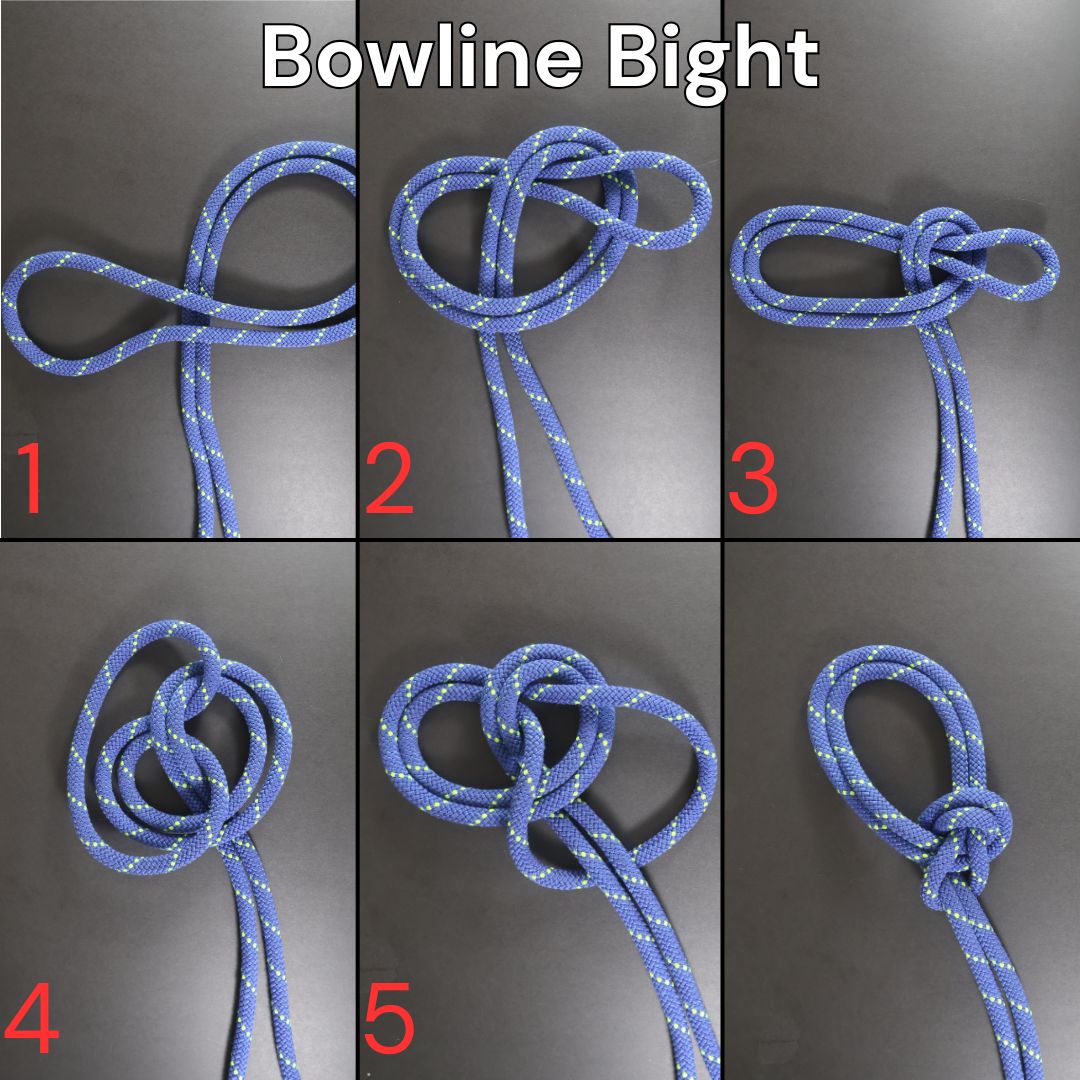
Bowline on a Bight Instructions
The Bowline on a Bight is a loop knot derived from the bowline. The Bowline on a Bight is widely used in rescue, climbing, scouting, and rope-access applications where a secure pair of loops is required without using the rope’s ends. Its structure is based on the classic bowline but is tied using a doubled section of rope, allowing two fixed loops to be formed simultaneously. This design provides versatility and convenience while retaining many of the desirable characteristics of the traditional bowline. The Bowline on a Bight is included in The Ashley Book of Knots (ABOK #1080) and has long been recognized as a useful and practical loop knot. If you’re looking for a Double Bowline with a single loop, see the Water Bowline. Also see the Spanish Bowline for a Bowline variation with two loops.
Key Considerations
Proper dressing of the Bowline on a Bight is important to ensure the knot is correctly formed and performs as intended. The loops should be arranged neatly, and the knot tightened carefully so that all parts of the structure are properly seated. Careful dressing and setting help maximize stability and reduce the risk of incorrect tying. As with all load-bearing knots, the finished knot should be visually inspected and checked before use to confirm that it has been tied correctly and that the loops are properly formed.
Advantages & Disadvantages
One of the key advantages of the Bowline on a Bight is its ability to create two secure fixed loops without access to the ends of the rope. It remains relatively easy to untie after loading and can be tied efficiently with practice, making it a practical choice in situations where both reliability and convenience are important. The knot is especially useful in rescue and emergency situations, where the twin loops can be used for supporting a person or distributing a load. However, like any knot used in life-safety applications, it should only be used by individuals who are properly trained in its construction, inspection, and appropriate use.
ABOK #1080 - Bowline on a Bight
ABOK Numbers: Abok #1080, Abok #1081, Abok #1082
The Bowline on the Bight is featured in Ashley’s Book of Knots with three consecutive entries. Each entry is a different way to tie the Bowline on a Bight. The entries are as follows.
Abok #1080,
‘The Bowline, on, in, or upon, the bight, or a bight, mentioned by Lever in 1808, who called it “Bowline upon bight.” Roding gives a picture of it in 1795. It consists of two parallel rigid loops which may be used individually if desired. The pull the two ends should be approximately parallel. It is the knot generally used at sea for lowering an injured man from aloft. One leg is put through each loop and if conscious the man holds the double standing part in hand, but, if unconscious, a Single Hitch from the standing part is placed around his chest and under his armpits. To tie: Double a line, and with the loop end, tie a Bell Ringer’s Knot (1147), as in the second diagram. Then open the single end loop and pass it around the whole knot and close it about the neck of the knot, as pictured. Draw out the two loops and the knot will be complete.’
Abok #1081,
‘A second method of tying the Bowline on the bight: Double a rope and tie an Overhand Knot with the looped end. Following the diagram, fold the loop up over the front of the knot, placing the bight across the neck. Holding the loop in place, pull forward the double part that is indicated by the arrow in the second diagram and work the knot taut.’
Abok #1082,
‘A third way to tie the Bowline on the bight: Tie an Overhand Knot with a looped end, exactly as in the foregoing knot. Double the loop back, but this time double it underneath instead of on top. The doubled bight that is marked with an arrow in the right lower diagram forms the two loops. The material from the single loop is worked out and the knot drawn taut.’
Disclaimer
The information on this website is provided for educational and informational purposes only. While every effort has been made to ensure accuracy, knot strength, security, and suitability can vary depending on rope type, condition, load, environmental factors, and how the knot is tied. Users are responsible for inspecting their equipment and verifying that a knot is appropriate for their intended use. Do not rely solely on the information provided here for activities involving personal safety, life support, climbing, rescue operations, heavy lifting, or other high-risk applications.
SCB Media Group assumes no responsibility or liability for any injury, loss, damage, or consequences resulting from the use or misuse of the knots and techniques described. Always seek professional instruction and follow applicable safety standards where appropriate.