
How to Tie the Double Alpine Butterfly Loop Knot
The Double Alpine Butterfly
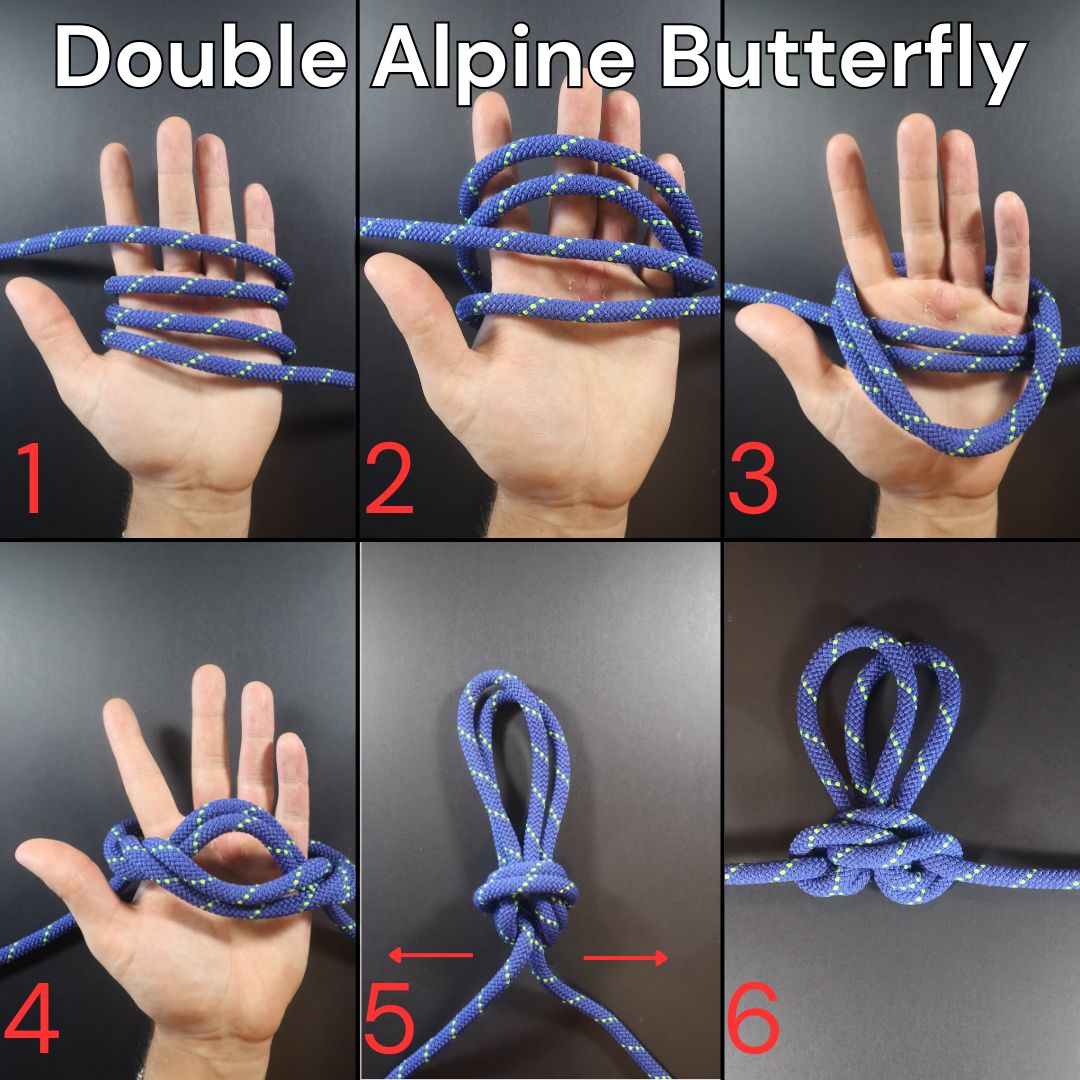
The Double Alpine Butterfly Loop is a variation of the Alpine Butterfly Loop used to create two secure fixed loops in the middle of a rope. It is valued for providing multiple attachment points while retaining the strength, stability, and multidirectional loading capabilities that make the standard Alpine Butterfly Loop so popular. Because of this combination of versatility, reliability, and practicality, the Double Alpine Butterfly Loop is commonly used in climbing, rescue, rigging, and general rope-work applications whenever two midline loops are required.
Other Names: Double Butterfly Loop, Double Alpine Butterfly, Double Butterfly Knot, Double Lineman's Loop, Double Lineman's Rider
Double Alpine Butterfly Instructions
First and foremost, the Double Alpine Butterfly Loop is a loop knot. Today, the Double Alpine Butterfly Loop is used in rescue, rigging, and rope-access applications where multiple attachment points are beneficial. Its structure is based on the Alpine Butterfly Loop but is tied in a way that creates two separate fixed loops rather than one. This modification allows loads to be distributed across multiple connection points while maintaining many of the characteristics of the original Alpine Butterfly, including stability under load and resistance to jamming.
The Double Alpine Butterfly Loop is generally recognized as a variation of the Alpine Butterfly Loop rather than a completely separate knot and is commonly referenced in modern knot-tying resources, including in The Ashley Book of Knots as a variation of ABOK #1053, the Alpine Butterfly Loop.
Key Considerations
Proper dressing of the Double Alpine Butterfly Loop is important to ensure the loops are formed correctly and the knot performs as intended. Both loops should be arranged neatly and tightened carefully so that all parts of the knot are properly seated and balanced. Careful dressing and setting help maximize stability, maintain equal loop formation, and reduce the risk of incorrect tying. As with all load-bearing knots, the finished knot should be visually inspected before use to confirm that the structure is correctly formed and that both loops are secure.
It is important to distinguish the differences between the structure of the Double Alpine Butterfly and that of the Alpine Butterfly, but more importantly, that of the Artillery Loop. The Artillery Loop Knot is a very inferior knot, structurally, to that of the Double Alpine Butterfly. Especially in critical situations, tying the wrong structure can have dire consequences. Make sure to examine your knots carefully, especially in situations where two knots can look similar or identical but function differently.
Commonly online, the Artillery Loop is said to be a synonym of the Alpine Butterfly. This is not correct. These are two very different knots.
Advantages & Disadvantages
One of the key advantages of the Double Alpine Butterfly Loop is its ability to provide two secure midline loops while retaining the strength and reliability of the standard Alpine Butterfly Loop. It can be tied efficiently with practice and remains practical in situations where multiple attachment points are needed without access to the ends of the rope. This makes it particularly useful for rescue systems, load distribution, and specialized rigging applications.
Quite frequently, we find it challenging to tie larger loops using the ‘hand method’ pictured here in both the video and image. See the Spanish Bowline for an alternative to this problem; it is another great loop knot it is.
Like any knot used in life-safety situations, it should only be used by individuals who are properly trained in its construction, inspection, and appropriate use.
Disclaimer
The information on this website is provided for educational and informational purposes only. While every effort has been made to ensure accuracy, knot strength, security, and suitability can vary depending on rope type, condition, load, environmental factors, and how the knot is tied. Users are responsible for inspecting their equipment and verifying that a knot is appropriate for their intended use. Do not rely solely on the information provided here for activities involving personal safety, life support, climbing, rescue operations, heavy lifting, or other high-risk applications.
SCB Media Group assumes no responsibility or liability for any injury, loss, damage, or consequences resulting from the use or misuse of the knots and techniques described. Always seek professional instruction and follow applicable safety standards where appropriate.