
How to Tie the Cowboy Bowline
The Cowboy Bowline
The Cowboy Bowline is a variation of the bowline knot used to create a secure fixed loop in a rope, making it useful for general-purpose tying in climbing, rescue, sailing, and outdoor applications. It is valued for forming a reliable, non-slip loop that does not tighten under load and can still be untied easily after use. Because of this balance of strength and convenience, it is commonly used whenever a dependable end-of-line loop is needed for attaching to anchors, hardware, or other ropes.
Other Names: Dutch Bowline, Left-Handed Bowline, Reverse Bowline, Dutch Marine Bowline, Outside Bowline
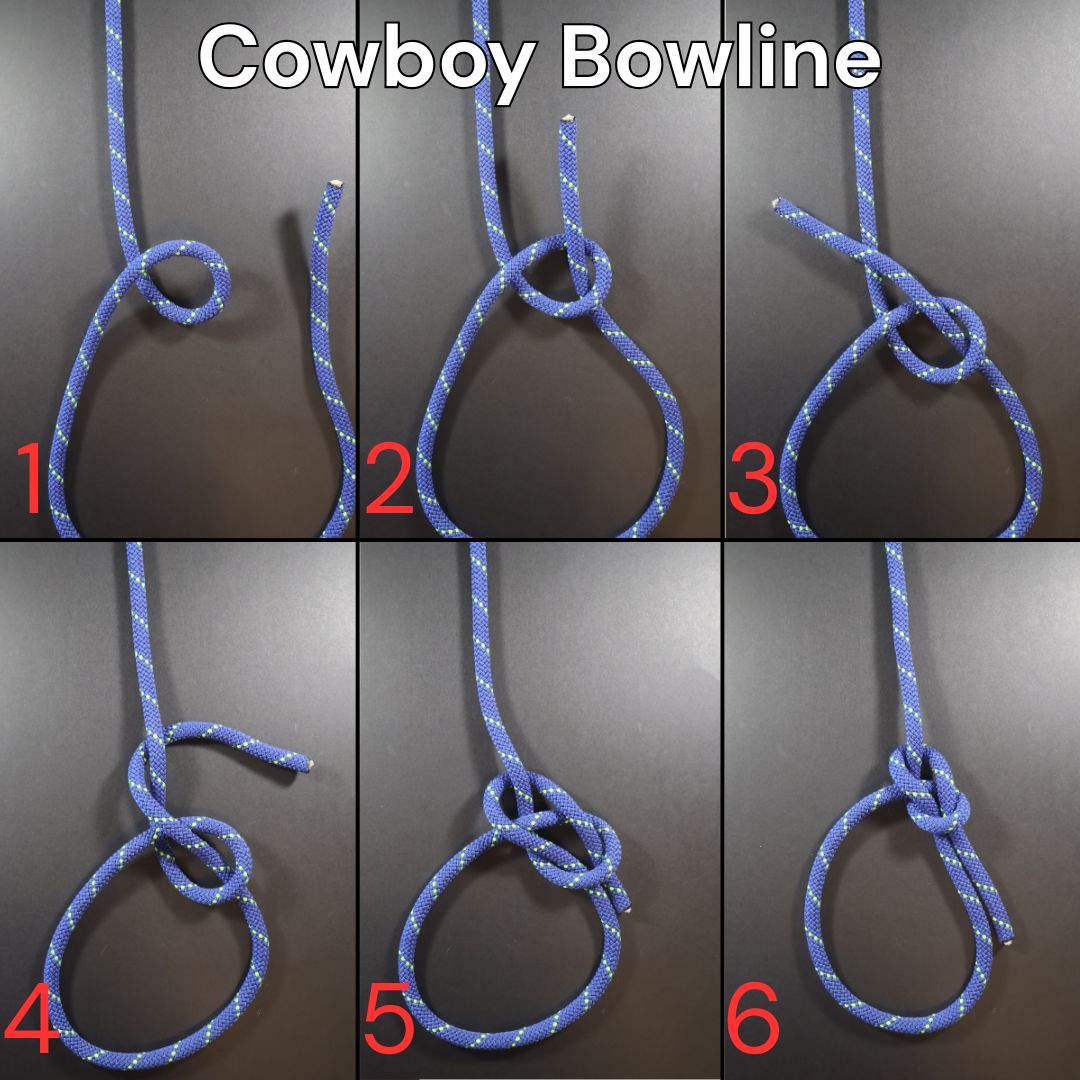
Cowboy Bowline Instructions
Today, the Cowboy Bowline is a loop knot widely taught in climbing, rope work, and outdoor skills training due to its simplicity and familiarity within the bowline family. Its structure is functionally very similar to the standard bowline, but it is tied in a slightly different direction, which can change how it dresses and loads. The Cowboy Bowline is listed in The Ashley Book of Knots (ABOK #1034 1/2), it is understood as a variation of the classic bowline rather than a completely distinct knot.
Key Considerations
Proper dressing of the Cowboy Bowline is important to ensure the loop is neat and the knot seats correctly under load. As with all bowline-type knots, maintaining a consistent structure helps prevent slippage and ensures predictable performance. It should be checked after tying to confirm that the loop is properly formed and the tail is adequately set. The Cowboy Bowline is correctly tied when the tag end is outside of the loop. Whereas in the traditional bowline, the tag end finishes in the knot. However, the Cowboy Bowline is not the only bowline where the tag end finishes outside of the loop. Take the Yosemite Bowline, or Scott’s Locked Bowline, for example. Both bowline variations feature tag ends that head out of the loop or alongside the outside of the loop. Whether this tag end finish makes a difference can be subjective, but it’s definitely noticeable visually and clearly distinguishes the Cowboy Bowline from the traditional bowline.
Advantages & Disadvantages
One of the key advantages of the Cowboy Bowline is its simplicity. It can be tied quickly with practice and requires minimal steps, making it practical in situations where efficiency matters. However, like all bowline variations, it is generally intended for non-critical or properly backed-up applications in modern safety contexts, especially in climbing or rescue environments where additional security measures may be required.
Abok #1034 1/2 - Left Hand Bowline Knot
ABOK Numbers: Abok #1034 1/2
In Ashley’s Book of Knots, the Cowboy Bowline is known as the Left Hand Bowline. Referenced in the book, the Cowboy Bowline is referenced as,
‘In formation the Left-Hand Bowline Knot is similar to the Left-hand Sheet Bend (#67). It is often tied directly around a post, in mooring (probably by mistake), instead of tying a Righthand Bowline (1010), to which it is distinctly inferior.’
Now, in the book, it references the Cowboy Bowline as ‘distinctly inferior‘ to the right-hand bowline (traditional bowline). However, taking this at face value would be irresponsible, as this has been a subjective issue on the internet for a long debate. Some people prefer the Cowboy Bowline, and some prefer the traditional bowline.
Disclaimer
The information on this website is provided for educational and informational purposes only. While every effort has been made to ensure accuracy, knot strength, security, and suitability can vary depending on rope type, condition, load, environmental factors, and how the knot is tied. Users are responsible for inspecting their equipment and verifying that a knot is appropriate for their intended use. Do not rely solely on the information provided here for activities involving personal safety, life support, climbing, rescue operations, heavy lifting, or other high-risk applications.
SCB Media Group assumes no responsibility or liability for any injury, loss, damage, or consequences resulting from the use or misuse of the knots and techniques described. Always seek professional instruction and follow applicable safety standards where appropriate.