
How to Tie Scott's Locked Bowline
Scott's Locked Bowline
The Scott's Locked Bowline is a secure variation of the bowline knot used to create a fixed loop in a rope, making it suitable for climbing, rescue, and other applications where additional security is desired. It is valued for its locking structure, which helps prevent the knot from loosening or capsizing while still retaining many of the bowline's advantages, including the ability to be untied relatively easily after loading. Because of this combination of security, strength, and practicality, the Scott's Locked Bowline is commonly used whenever a reliable end-of-line loop is needed for attaching to harnesses, anchors, or other fixed points.
Other Names: Secured Bowline, Locked Bowline
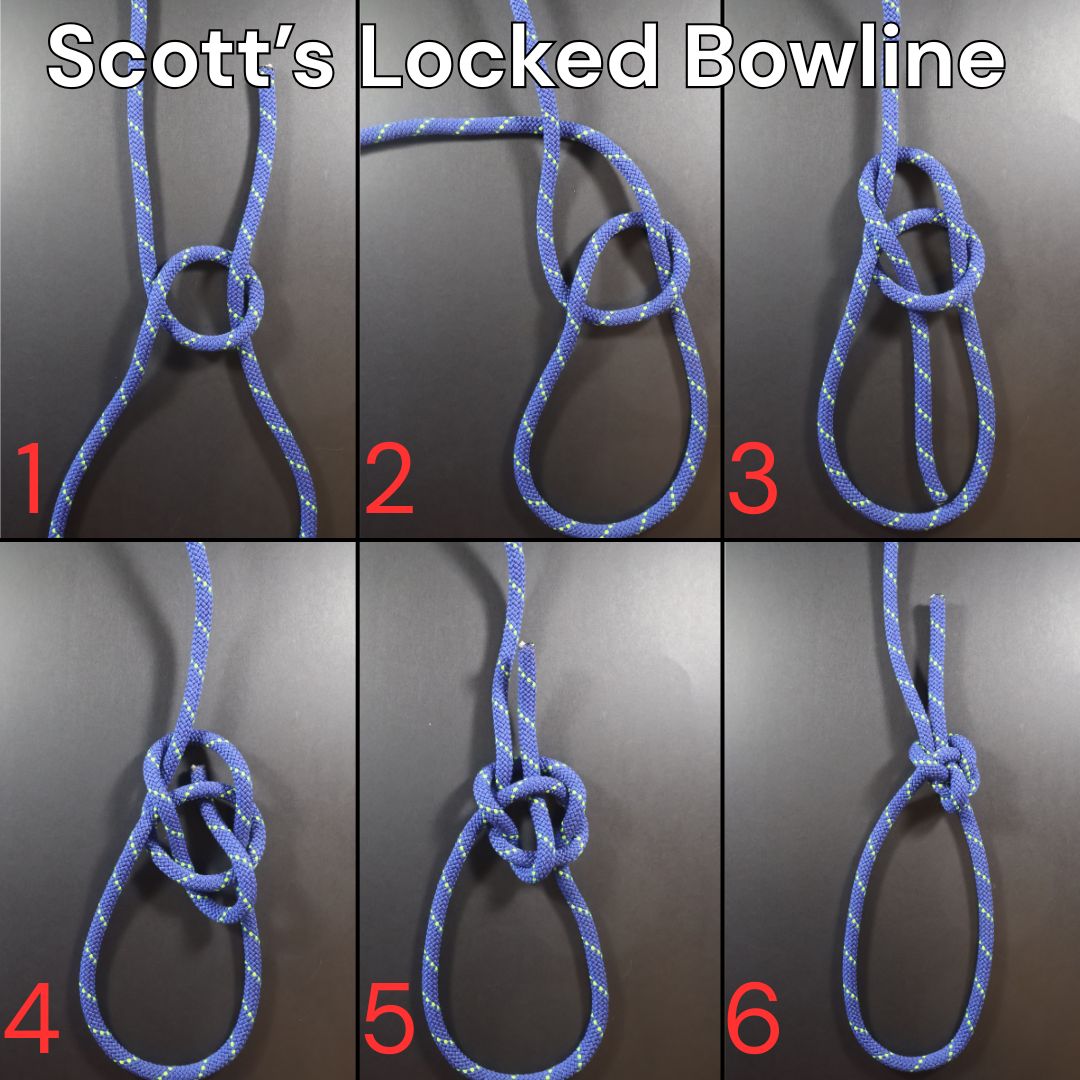
Scott's Locked Bowline Instructions
Today, the Scott’s Locked Bowline is used in climbing, rescue, and rope-access applications where greater security than a standard bowline is preferred. Its structure is based on the classic bowline but incorporates an additional locking arrangement that secures the tail and helps stabilize the knot under load. This modification improves resistance to loosening and enhances overall reliability while maintaining the bowline’s familiar form and functionality. The Scott’s Locked Bowline is generally recognized as a bowline variation designed to provide increased security compared to the traditional bowline. Scott’s Locked Bowline is not in The Ashley Book of Knots (ABOK).
Key Considerations
Proper dressing of the Scott’s Locked Bowline loop knot is important to ensure the knot is correctly formed and performs as intended. The locking portion of the knot must be routed properly and tightened carefully so that all parts of the structure are neatly aligned. Other variations of the Bowline, such as the Edwards Bowline or Yosemite Bowline, may also be used depending on the situation. Careful dressing and setting help maximize security and reduce the risk of incorrect tying. As with all bowline variations, the finished knot should be visually inspected and checked before use to confirm that it has been tied correctly and that an adequate tail remains.
Advantages & Disadvantages
One of the key advantages of the Scott’s Locked Bowline is its combination of enhanced security and ease of untying after heavy loading. It retains many of the desirable characteristics of the traditional bowline while providing additional resistance to loosening, making it a useful option when a more secure fixed loop is required. It can be tied efficiently with practice and remains practical in situations where both reliability and convenience are important. However, like any knot used in life-safety applications, it should only be used by individuals who are properly trained in its construction, inspection, and appropriate use.
Disclaimer
The information on this website is provided for educational and informational purposes only. While every effort has been made to ensure accuracy, knot strength, security, and suitability can vary depending on rope type, condition, load, environmental factors, and how the knot is tied. Users are responsible for inspecting their equipment and verifying that a knot is appropriate for their intended use. Do not rely solely on the information provided here for activities involving personal safety, life support, climbing, rescue operations, heavy lifting, or other high-risk applications.
SCB Media Group assumes no responsibility or liability for any injury, loss, damage, or consequences resulting from the use or misuse of the knots and techniques described. Always seek professional instruction and follow applicable safety standards where appropriate.