
How to Tie the Double Dragon Loop Knot
The Double Dragon Loop
The Double Dragon Loop is a fixed-loop knot used to create a strong and secure loop at the end of a rope, making it useful for climbing, rescue work, rigging, boating, and general outdoor applications. It is valued for its strength, stability, and resistance to jamming, providing a reliable loop that remains secure under load while often being easier to untie afterward than many other high-strength loop knots. Because of this combination of security and practicality, it is commonly used whenever a dependable end-of-line loop is needed for attaching to anchors, hardware, or other rope systems.
Other Names: Double Dragon, Double Dragon Fixed Loop, Double Dragon Bowline
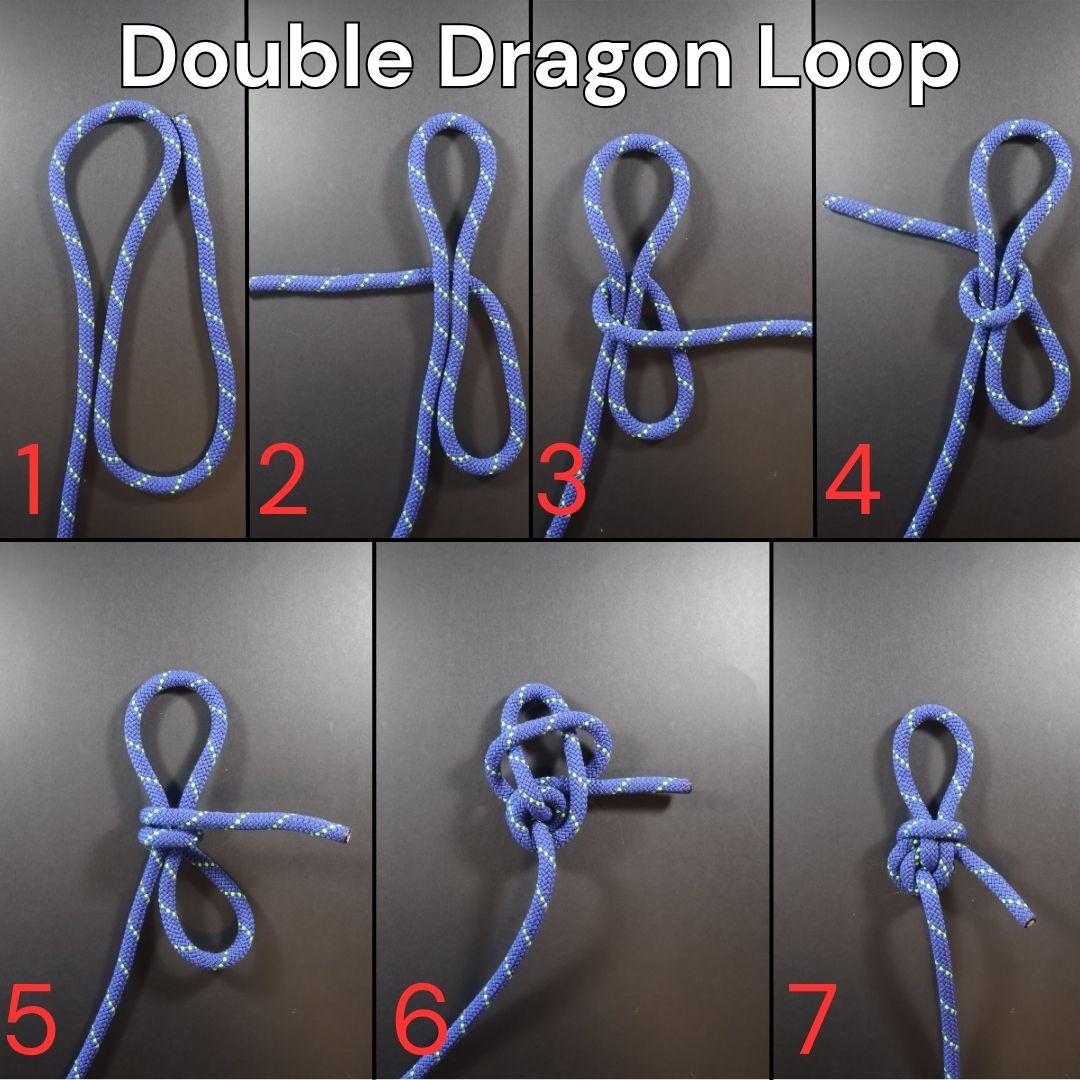
Double Dragon Loop Knot Instructions
Today, the Double Dragon Loop is recognized as a modern loop knot designed to provide an alternative to traditional fixed-loop knots such as the bowline and figure-eight loop. Its structure forms a symmetrical loop with multiple wraps around the standing part, helping distribute load efficiently and improving overall stability. Unlike many traditional loop knots, the Double Dragon Loop is specifically designed to maintain its shape under tension while reducing the likelihood of loosening or deformation during repeated loading. The Double Dragon Loop is not formally listed in The Ashley Book of Knots (ABOK).
Key Considerations
Proper dressing of the Double Dragon Loop is important to ensure the knot is correctly formed and all turns are neatly aligned before loading. Careful attention to the final structure helps maximize strength, maintain stability, and ensure consistent performance. As with any knot used in critical applications, it should be inspected after tying to verify that the loop is properly formed and the tail is adequately secured.
Advantages & Disadvantages
One of the key advantages of the Double Dragon Loop is its excellent balance of strength, security, and ease of untying after heavy loads. It can be tied efficiently with practice and performs well in situations where a stable, non-slipping loop is required. Its resistance to jamming and dependable performance have contributed to its growing popularity among climbers, rescuers, sailors, and rope enthusiasts seeking a strong and versatile fixed-loop knot.
Disclaimer
The information on this website is provided for educational and informational purposes only. While every effort has been made to ensure accuracy, knot strength, security, and suitability can vary depending on rope type, condition, load, environmental factors, and how the knot is tied. Users are responsible for inspecting their equipment and verifying that a knot is appropriate for their intended use. Do not rely solely on the information provided here for activities involving personal safety, life support, climbing, rescue operations, heavy lifting, or other high-risk applications.
SCB Media Group assumes no responsibility or liability for any injury, loss, damage, or consequences resulting from the use or misuse of the knots and techniques described. Always seek professional instruction and follow applicable safety standards where appropriate.