
How to Tie the Mooring Hitch
The Mooring Hitch
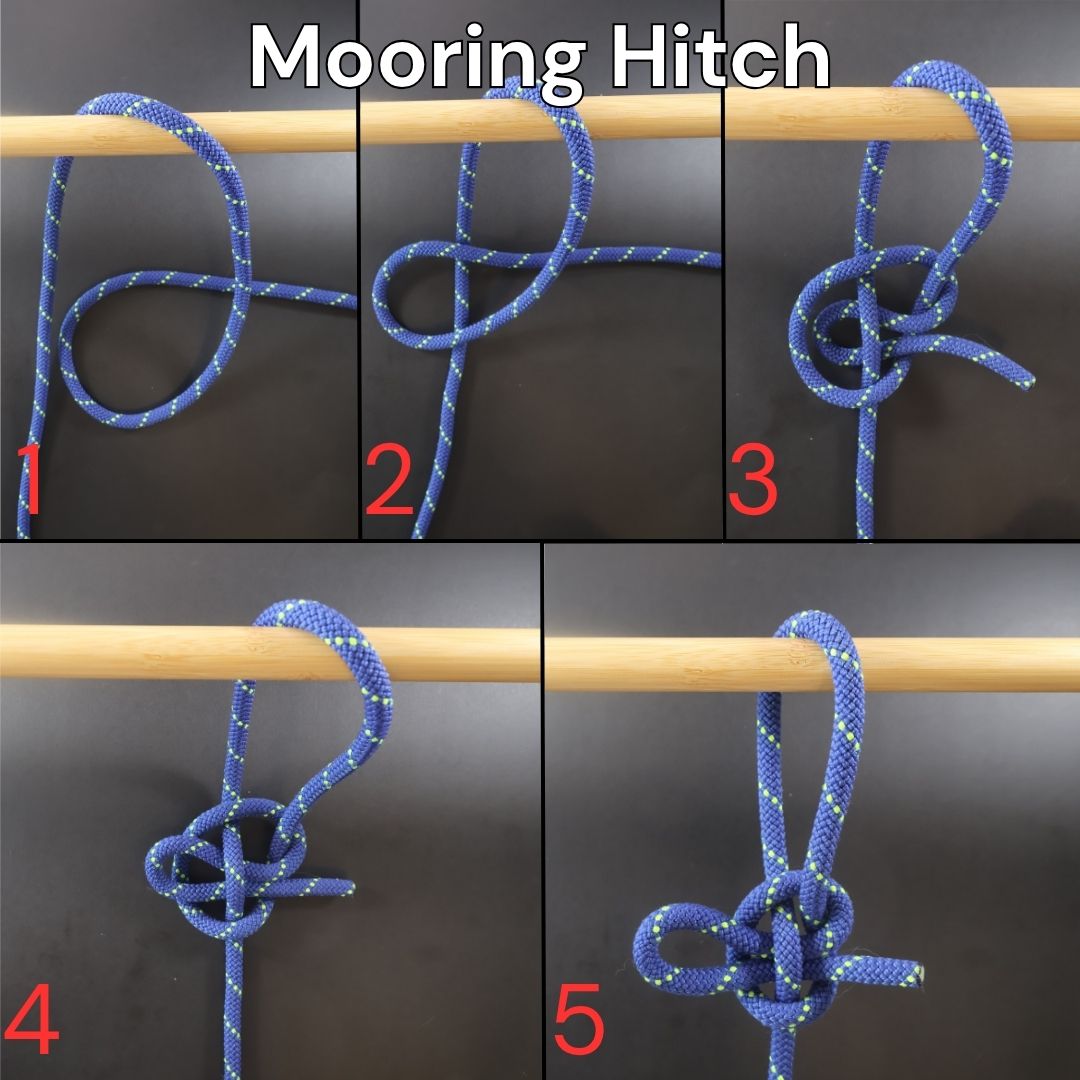
The mooring hitch is a practical knot used to temporarily secure a boat to a dock, post, ring, or mooring point. It is valued for its ability to hold firmly under tension while remaining relatively easy to release, even after being subjected to a heavy load. Because of these characteristics, it is commonly used by boaters when making short stops or when a vessel needs to be quickly secured and later released.
Mooring Hitch Instructions
Today, the Mooring Hitch remains a fundamental hitch knot taught in boating, sailing, and seamanship courses. Its combination of simplicity, reliability, and ease of release has made it a longstanding favourite among mariners around the world. With a quick-release feature similar to the quick-release bowline or Kalymk loop, it serves as a quicker alternative; however, the Mooring Hitch is a hitch knot rather than a loop knot like the other knots mentioned.
Key Considerations
Leaving lots of tag-end at the end of the Mooring Hitch is very important. Think a good foot or two; the same goes for the quick-release bight; this should be at least one foot in total length. In doing so, you eliminate almost all possibility of slippage from the Mooring Hitch.
Advantages & Disadvantages
One of the key advantages of the mooring hitch is its speed. A sailor can secure a boat in seconds without needing complex knotwork, yet still trust that the vessel will remain attached while under normal loads. However, because it is generally considered a temporary fastening knot, it is not always recommended for long-term unattended mooring in rough conditions. For extended mooring, additional lines or more secure knots may be used (see Water Bowline or Round Turn & Two Half Hitches)
ABOK #1791 - The Mooring Hitch
The Ashley Book of Knots (ABOK) describes the Mooring Hitch as: “‘Mooring Hitch’ appears to be a fairly old name for the Magnus or Rolling Hitch when made fast to a post. The merit of the hitch is that, when snugly applied, it will not slip down the post. Anyone who has found himself at full tide, after a hard day’s fishing, with his painter fast to a stake four or five feet below high-water mark, will be inspired to learn this knot.”
Keep in mind Abok #1791 is NOT the Mooring Hitch demonstrated on this page. The Mooring Hitch on this page is not featured in Abok to our knowledge.
Disclaimer
The information on this website is provided for educational and informational purposes only. While every effort has been made to ensure accuracy, knot strength, security, and suitability can vary depending on rope type, condition, load, environmental factors, and how the knot is tied. Users are responsible for inspecting their equipment and verifying that a knot is appropriate for their intended use. Do not rely solely on the information provided here for activities involving personal safety, life support, climbing, rescue operations, heavy lifting, or other high-risk applications.
SCB Media Group assumes no responsibility or liability for any injury, loss, damage, or consequences resulting from the use or misuse of the knots and techniques described. Always seek professional instruction and follow applicable safety standards where appropriate.