
How to Tie the Handcuff Knot
The Handcuff Knot
The Handcuff Knot is a quick-forming knot that creates two adjustable loops side by side. It is primarily known for producing a pair of tightening loops that can be drawn together under tension. While simple in structure, it is not a highly secure load-bearing knot and is generally intended for temporary or light-duty applications where rapid formation is more important than long-term stability.
Handcuff Knot Instructions
Today, the Handcuff Knot is most often seen in instructional knot-tying, survival demonstrations, and general rope practice. It can be used in practical outdoor settings for temporary bundling, securing loose items, or improvised handling tasks where two adjustable loops are useful. In some contexts it is also referenced in rescue or emergency training, though its use depends heavily on the situation and proper understanding of its limitations.
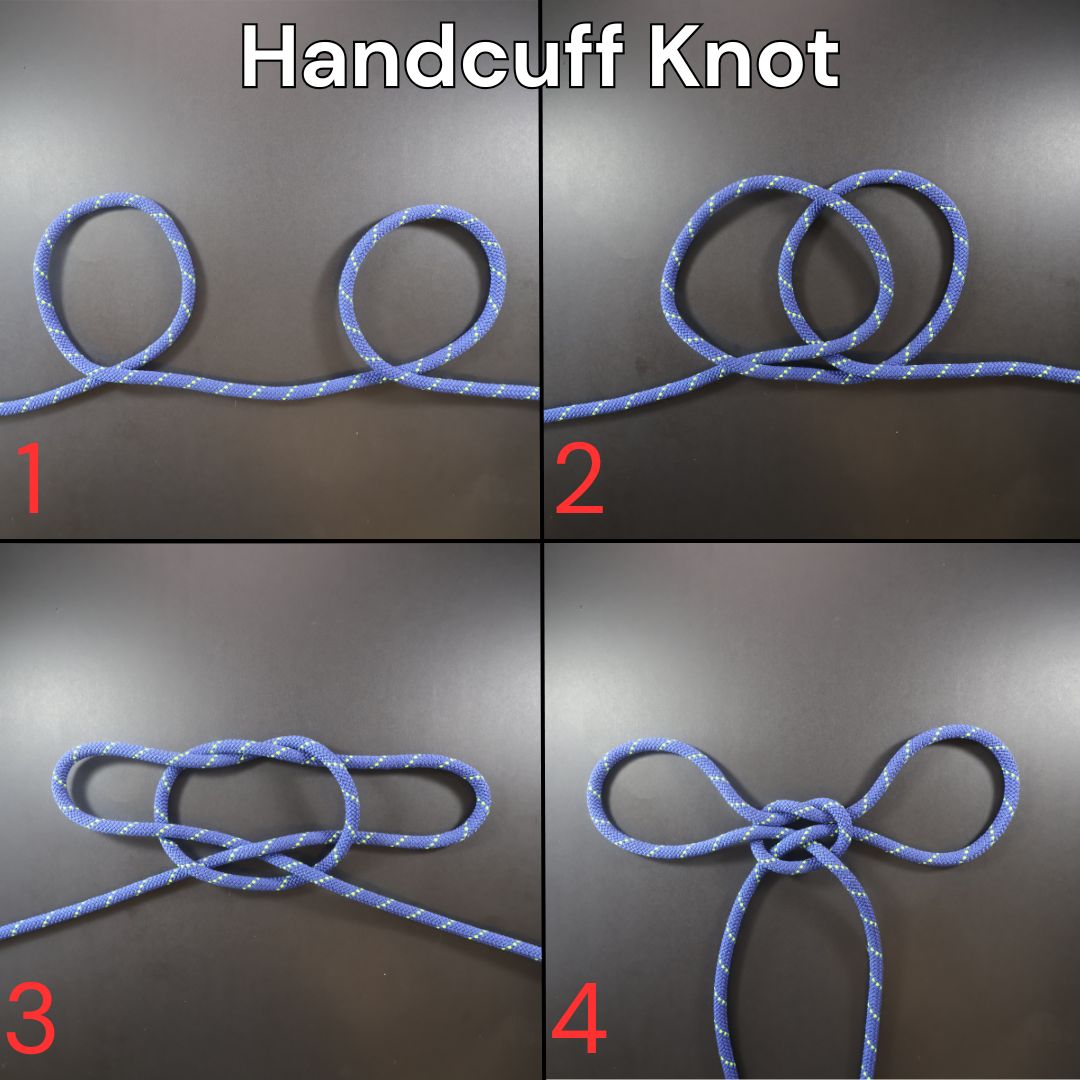
Key Considerations
When tying the Handcuff Knot, leaving sufficient loop size at the beginning is important to make sure it fits around your object(s) fully before tightening. Like all knots, proper dressing and tightening are essential to ensure the structure holds its intended shape during use.
Advantages & Disadvantages
One of the key advantages of the Handcuff Knot is its speed and ability to form two functional loops quickly from a single line, making it useful in time-sensitive situations. However, its main disadvantage is that it can be unreliable under sustained or uneven load, and the loops may tighten unpredictably depending on how it is used. For this reason, it is best suited to temporary or non-critical applications rather than safety-critical tasks.
ABOK #1134 - The Handcuff Knot
Ashley’s Book of Knots describes the Handcuff Knot as: “The Handcuff Knot, per se, is, however, a firmer knot, less apt to spill while being put to work, and consequently to be preferred to the Tom Fool’s Knot. A Loop having been adjusted around each wrist, both ends are pulled on to tighten the knot; finally a hitch is added to each end around the neck of the loop, close up to the wrist.”
Disclaimer
The information on this website is provided for educational and informational purposes only. While every effort has been made to ensure accuracy, knot strength, security, and suitability can vary depending on rope type, condition, load, environmental factors, and how the knot is tied. Users are responsible for inspecting their equipment and verifying that a knot is appropriate for their intended use. Do not rely solely on the information provided here for activities involving personal safety, life support, climbing, rescue operations, heavy lifting, or other high-risk applications.
SCB Media Group assumes no responsibility or liability for any injury, loss, damage, or consequences resulting from the use or misuse of the knots and techniques described. Always seek professional instruction and follow applicable safety standards where appropriate.
Kalmyk Loop
Poacher's Knot
Bowline
Spanish Bowline
Rope Knot Categories
- Stopper Knots
- Hitch Knots
- Loop Knots
- Bend Knots
- Binding Knots
Fishing Knot Categories