
How to Tie the Handcuff Knot
The Handcuff Knot
The Handcuff Knot is a binding knot used to create two adjustable loops (rope handcuffs) that tighten when pulled, making it useful for restraint, securing objects, emergency applications, and various forms of rope work. It is valued for its simple construction and ability to form a pair of sliding loops from a single piece of rope. Because of this combination of versatility, speed, and practicality, the Handcuff Knot is commonly used whenever two adjustable loops are needed to hold, secure, or temporarily restrain an object.
Other Names: Hobble Knot, Rope Handcuffs
Handcuff Knot Instructions
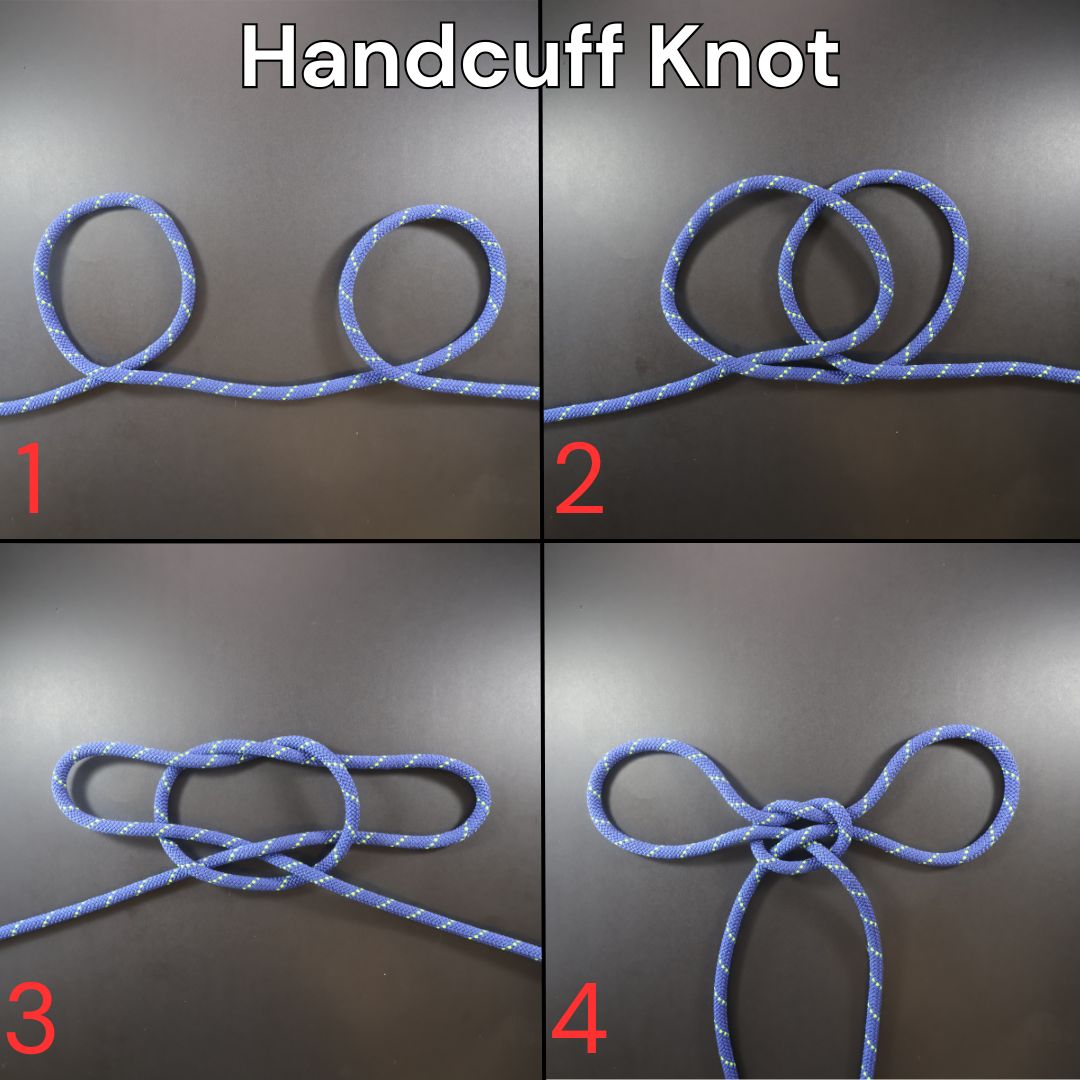
The Handcuff Knot is a loop knot (or binding knot) used in scouting, camping, survival training, and general rope work applications where a quick and effective binding is desired. Its structure consists of two interconnected overhand loops arranged so that each loop can slide and tighten independently when tension is applied. This design allows the knot to adapt to different sizes and shapes while remaining relatively easy to tie. The Handcuff Knot (rope handcuffs) are included in The Ashley Book of Knots (ABOK #1140). The Handcuff Knot is not the Tom Fool’s Knot or the Fireman’s Chair Knot. Many internet resources portray these as the same knot. This is false.
For more multi-loop knots, see the Spanish Bowline, Double Figure Eight Loop, or Double Alpine Butterfly.
Key Considerations
Proper dressing of the Handcuff Knot is important to ensure the loops are formed correctly and the knot functions as intended. The two loops should be arranged neatly and positioned so they slide freely when tension is applied. Careful dressing helps maintain smooth operation and reduces the likelihood that the knot will become twisted or improperly configured. As with all loop knots, the finished knot should be inspected before use to confirm that both loops are correctly formed and operating properly.
Advantages & Disadvantages
One of the key advantages of the Handcuff Knot is its ability to create two adjustable loops quickly using a minimal amount of rope. It can be tied efficiently with practice and remains practical in situations where speed and simplicity are important. The knot is commonly demonstrated as a classic scouting and survival knot and can be adapted for a variety of securing tasks. However, it is not intended as a life-safety knot and should not be relied upon for climbing, rescue, or any application where human life depends on its performance. See the Spanish Bowline as an alternative for a multi-loop knot.
ABOK #1140 - The Handcuff Knot
ABOK Numbers: Abok #412, Abok #1134, Abok #1140, Abok #2292
The Handcuff Knot is featured four times in the Ashley Book of Knots. Each time the Handcuff Knot is featured, the description is slightly altered, so here is each description in sequential order.
Abok #412,
‘After adjustment around the wrists of a culprit, the ends are half hitched around the neck of the loops (see 1140). The Tom Fool’s Knot (#1141) has also been used for the same purpose and in the same manner.’
Abok #1134,
‘The Handcuff Knot, per se, is, however, a firmer knot, less apt to spill while being put to work, and consequently to be preferred to the Tom Fool’s Knot. A loop having been adjusted around each wrist, both ends are pulled on to tighten the knot; finally a hitch is added to each end around the neck of the loop, close up to the wrist.’
Abok #1140,
‘The Handcuff Knot is often confused with the Tom Fool’s Knot. But it is commenced with a Clove Hitch while the latter knot is evolved from a round turn. After the Handcuff Knot has drawn up snugly, each end may be half hitched around one of the loops to render the knot secure.’
Abok #2292,
‘The Handcuff Knot cannot be arranged to coincide with the diagram of #2290 but easily conforms to 2291.’
Disclaimer
The information on this website is provided for educational and informational purposes only. While every effort has been made to ensure accuracy, knot strength, security, and suitability can vary depending on rope type, condition, load, environmental factors, and how the knot is tied. Users are responsible for inspecting their equipment and verifying that a knot is appropriate for their intended use. Do not rely solely on the information provided here for activities involving personal safety, life support, climbing, rescue operations, heavy lifting, or other high-risk applications.
SCB Media Group assumes no responsibility or liability for any injury, loss, damage, or consequences resulting from the use or misuse of the knots and techniques described. Always seek professional instruction and follow applicable safety standards where appropriate.