
How to Tie the Siberian Hitch
The Siberian Hitch
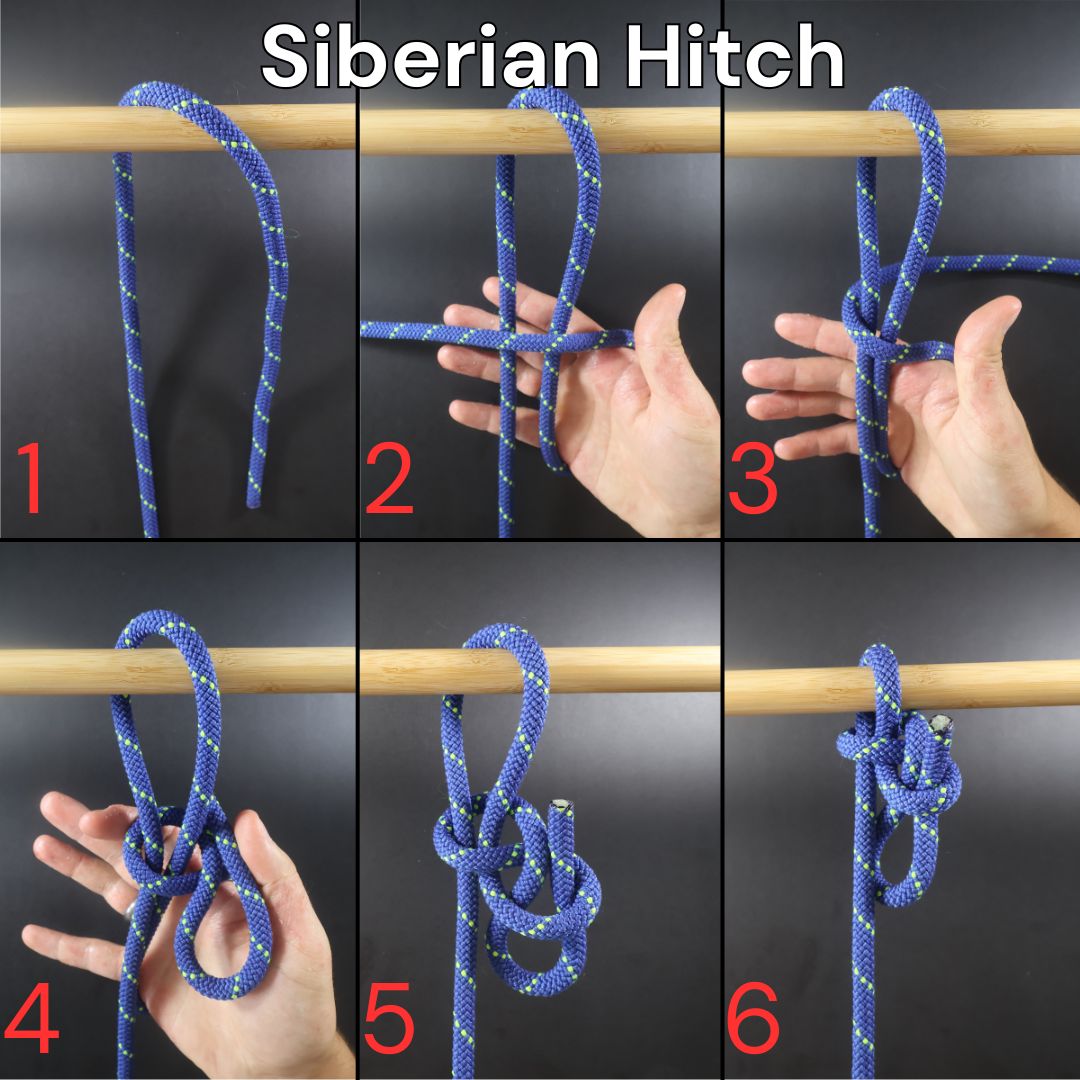
The Siberian Hitch is a quick-release knot used to temporarily secure a rope to a post, ring, or anchor point, making it especially useful in cold-weather camping, bushcraft, and outdoor survival situations. It is valued for its ability to hold firmly under tension while still being easy to release with a single pull on the free end, even after bearing a significant load. Because of this balance of security and convenience, it is commonly used when a line needs to be set and released quickly, such as tying tarps, tents, or temporary shelters.
Other Names: Evenk Knot, Evenk Hitch
Siberian Hitch Instructions
Today, the Siberian Hitch is widely taught in bushcraft, wilderness survival, and outdoor skills courses due to its simplicity and speed. Its combination of fast tying, reliable holding power, and easy release has made it a practical choice for situations where efficiency matters. Functionally, it is similar in purpose to other quick-release hitch knots like the Highwayman’s Hitch or Kalmyk Loop, but it is specifically a hitch knot rather than a loop knot.
Key Considerations
Leaving an adequate tag end is important when tying the Siberian Hitch, typically a good hand’s length or more, to ensure the knot cannot accidentally capsize or slip under load. The quick-release tail should also be accessible and long enough to be pulled cleanly when it is time to untie the knot. This helps eliminate the risk of jamming or accidental release during use.
Advantages & Disadvantages
One of the key advantages of the Siberian Hitch is its speed. It can be tied in seconds with minimal steps, making it ideal for cold environments where dexterity (also see Kalmyk Loop) may be limited, and it can also be tied effectively while wearing gloves or mitts. However, it is generally intended for temporary use and is not recommended for long-term or heavy, unattended loads, especially in harsh or unpredictable conditions. In such cases, more secure permanent hitching methods or backup knots may be preferred.
ABOK
The Siberian Hitch is not formally listed as a distinct knot in The Ashley Book of Knots (ABOK), but it is closely related in structure and function to other quick-release hitches and slipped loop variations found throughout the book. In practice, it most closely resembles a slipped Half Hitch combined with a locking bight, and it shares similarities with other quick-release mechanisms such as slipped bowline variants and temporary fastening hitches. While not catalogued as its own entry by Ashley, it fits within the broader family of simple, releasable hitches designed for fast tying and easy release under load.
Disclaimer
The information on this website is provided for educational and informational purposes only. While every effort has been made to ensure accuracy, knot strength, security, and suitability can vary depending on rope type, condition, load, environmental factors, and how the knot is tied. Users are responsible for inspecting their equipment and verifying that a knot is appropriate for their intended use. Do not rely solely on the information provided here for activities involving personal safety, life support, climbing, rescue operations, heavy lifting, or other high-risk applications.
SCB Media Group assumes no responsibility or liability for any injury, loss, damage, or consequences resulting from the use or misuse of the knots and techniques described. Always seek professional instruction and follow applicable safety standards where appropriate.